Selank and the anxiety and stress response: what the research shows

The short answer
Selank is a synthetic seven-amino-acid peptide built from the immune peptide tuftsin, developed in Russia, given as a nasal spray, and studied mainly for anxiety and stress. In rats it acts on the calming GABA system and raises BDNF. In people, one small Russian trial found anxiety relief similar to a benzodiazepine; larger, independent trials do not exist.
Selank is the peptide people reach for when the goal is calm rather than sharpness; it is routinely described online as a “natural” or “non-addictive” alternative to benzodiazepines for anxiety and stress. This page is a straight read of what Selank actually is and what the published science does and does not show. The short version: the mechanism is genuinely interesting and points at the brain’s own anti-anxiety systems, most of it has been demonstrated in animals, and the human data amount to a small number of older Russian studies. Here is the whole picture, sourced to the primary literature, plus what people who use it are saying. For how Selank compares with its cognition-focused sibling, see our companion piece on Selank versus Semax, and for a reference-style summary of the compound itself, the Selank monograph on The Treatment Report.
What is Selank?
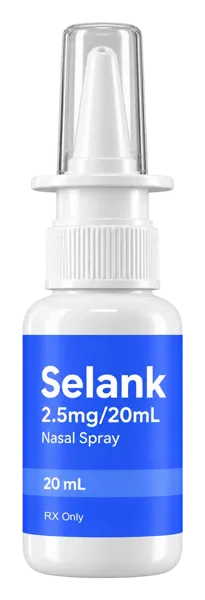
Selank is a synthetic heptapeptide (seven amino acids in the sequence Thr-Lys-Pro-Arg-Pro-Gly-Pro) engineered in Russia from the naturally occurring immune peptide tuftsin, and typically given as a nasal spray (see why in our Selank nasal spray guide). It was built by taking the tuftsin sequence (Thr-Lys-Pro-Arg) and attaching a C-terminal Pro-Gly-Pro tail, the same stabilizing trick used to make its better-known relative Semax; the added tail slows enzymatic breakdown so the peptide lasts longer and can be delivered intranasally (Kasian et al., 2017). Both peptides came out of the Institute of Molecular Genetics of the Russian Academy of Sciences, which is why they are so often grouped together as “Russian nootropics.”
The lineage matters, because it is where Selank and Semax genuinely diverge. Semax descends from a fragment of the stress hormone ACTH and is studied mainly for cognition and neuroprotection; Selank descends from an immune-modulating peptide and is studied mainly for anxiety, stress, and asthenia (fatigue). That immune ancestry is not incidental: it is part of why the research on Selank spans anxiety, stress physiology, and immune signaling at once. Essentially all of Selank’s clinical history sits inside Russia and neighboring countries, a fact that shapes everything about how to read the evidence below.
How is Selank thought to work on anxiety and stress?
Selank is thought to reduce anxiety mainly by modulating the brain’s inhibitory GABA system, with supporting roles from serotonin, the BDNF neurotrophic system, and the body’s own enkephalin peptides. But almost all of that mechanistic evidence comes from animals. GABA is the main “calming” neurotransmitter in the brain, and it is the same system benzodiazepines act on. In a chronic-stress study in male Wistar rats, Selank produced the most effective reduction in anxiety of the conditions tested, and when combined with the benzodiazepine diazepam it “almost completely eliminated the effects caused by stress,” returning anxiety measures toward the pre-stress baseline (Kasian et al., 2017). Crucially, the authors found that Selank does not bind the receptor the way a benzodiazepine does; instead it “can influence the specific binding of GABA to GABA-A receptors,” an allosteric modulation that may raise the receptor’s affinity, which is why the paper frames Selank as a way to potentially reduce the benzodiazepine dose rather than as a benzodiazepine itself.
The gene-expression work points the same direction. In a rat study of intranasal Selank, the peptide rapidly and dramatically altered the expression of genes encoding GABA-A receptor subunits (some dropping roughly 20-fold at one hour, then rising 13-to-16-fold at three hours), leading the authors to conclude that Selank likely acts through “allosteric modulation of the operation of the GABAergic system,” while also touching dopamine and serotonin pathways (Volkova et al., 2016). On serotonin specifically, a separate rat experiment found that Selank enhanced serotonin (5-HT) metabolism in the brainstem in animals whose serotonin synthesis had been chemically suppressed, an effect the parent peptide tuftsin did not share, which the authors read as a potential route to “correction of disturbances induced by a decrease in 5-HT metabolism” (Semenova et al., 2009). And on the neuroplasticity side, intranasal Selank was shown to regulate BDNF (brain-derived neurotrophic factor) expression in the rat hippocampus in vivo, raising Bdnf messenger RNA within hours and BDNF protein within a day at both doses tested (Inozemtseva et al., 2008).
Every one of those findings is real and biologically coherent: a fast GABAergic calming action layered over slower serotonergic and neurotrophic effects would plausibly explain both quick anxiety relief and gradual improvement. And every one was generated in rats or in tissue, not in people. So the honest framing is: there is a partly-mapped mechanism for how Selank could ease anxiety, demonstrated mostly in animals, not a proven chain from nasal spray to durable calm in humans.
What does the human research on Selank and anxiety actually show?
The human evidence for Selank in anxiety rests essentially on one small Russian trial, and it points to a benzodiazepine-comparable effect on a short timescale rather than a proven, replicated treatment. In that study, 62 patients with generalized anxiety disorder and neurasthenia were treated with either Selank (30 patients) or the benzodiazepine medazepam (32 patients), and assessed on the Hamilton, Zung, and Clinical Global Impression scales. Selank produced anxiolytic effects broadly similar to the benzodiazepine, and (unlike the benzodiazepine) it additionally showed anti-asthenic and psychostimulant properties, meaning it eased fatigue rather than causing sedation (Zozulia et al., 2008). That is a genuine and interesting signal: a peptide reaching benzodiazepine-like anxiety relief without the sedation is exactly why Selank draws attention.
But note carefully what that single study is and is not. It enrolled 62 people at a Russian center, was published in a Russian-language psychiatry journal, and has not been reproduced by independent Western groups in large, blinded trials. There is no published multi-site, placebo-controlled Western study establishing that Selank reliably reduces anxiety in the general population, and there is no long-term outcome data of the kind regulators require before endorsing a therapy. The frequently repeated online claim that Selank offers “benzo-level relief with no dependence” runs well ahead of that evidence: the comparison to a benzodiazepine comes from one small trial, and the absence of dependence, while plausible for a peptide with this mechanism, has not been established by the kind of long-term human safety studies that would actually prove it. A promising early human signal is not the same as a proven treatment. The same trial also took a biological measurement: patients with generalized anxiety disorder and neurasthenia started with a lower value on a blood serum measure of leu-enkephalin (one of the body’s own opioid peptides; the abstract reports it as tau 1/2 leu-enkephalin), that low value correlated with longer illness and more severe anxiety, fatigue, and autonomic symptoms, and it rose during Selank treatment, mostly in the generalized anxiety group (Zozulia et al., 2008). That is the human data point behind the enkephalin part of the mechanism story, and it is a biomarker shift in one small study, not proof of how the effect works. One newer human study adds a brain-imaging angle rather than a symptom measure: in 52 healthy participants given Selank, Semax, or placebo, resting-state fMRI showed effects on connectivity between the right amygdala, a key region for regulating anxiety, and the right temporal cortex (Panikratova et al., 2020). That shows the peptide does something measurable in the human brain; it does not show that anyone felt less anxious.
How does Selank compare with a benzodiazepine?
The single most repeated framing of Selank is “a benzodiazepine without the downsides,” and the honest version of that is narrower than the slogan. The comparison has a real basis: in the 62-patient trial, Selank’s anxiolytic effect was broadly comparable to medazepam, and the mechanistic work shows it acting on the same GABA system, but as an allosteric modulator rather than a direct receptor agonist (Zozulia et al., 2008; Kasian et al., 2017). That different mechanism is the plausible reason the study reported anti-asthenic and psychostimulant effects instead of the sedation and cognitive dulling associated with benzodiazepines.
The gap is in what has been proven. Benzodiazepines are long-established prescription medicines with decades of large controlled trials, defined dosing, and, importantly, a well-documented dependence and withdrawal profile that is precisely why they are prescribed cautiously. Selank has none of that documentation in either direction: not the large efficacy trials that would confirm the benefit, and not the long-term human safety studies that would confirm the absence of dependence. So “Selank is a safer benzodiazepine” is an overstatement of a much smaller fact, that one small trial found comparable short-term anxiety relief with a different, non-sedating side-effect profile. It is a reason for scientific interest, not a substitute for a proven, regulated anxiety treatment, and not a reason to self-treat an anxiety disorder without a clinician.
The table below lays out what the one head-to-head trial actually reported for each arm, so the comparison is visible at its real size.
| Attribute | Selank | Medazepam (benzodiazepine) |
|---|---|---|
| Patients | 30 | 32 |
| Who was treated | Generalized anxiety disorder and neurasthenia | Generalized anxiety disorder and neurasthenia |
| How it was measured | Hamilton, Zung, and Clinical Global Impression scales | Hamilton, Zung, and Clinical Global Impression scales |
| Anxiety relief | Similar to medazepam | Similar to Selank |
| Anti-fatigue and stimulating effects | Reported | Not reported in the abstract |
| Blood enkephalin marker | Rose during treatment, mostly in generalized anxiety patients | Not reported in the abstract |
Is Selank the best peptide for anxiety?
Of the peptides this site covers, Selank is the one studied mainly for anxiety, but “best” is not something the evidence can settle. Its human anxiety trials are small Russian studies that compared it with benzodiazepines, not with other peptides: medazepam in the 62-patient trial above (Zozulia et al., 2008) and phenazepam in a 60-patient comparison (Medvedev et al., 2014). So those trials say nothing about how Selank ranks against Semax, DSIP, or any other peptide for anxiety. What can be said is narrower: Selank is the one with published human anxiety trials and a mapped (mostly animal) calming mechanism, while Semax is studied mainly for cognition and DSIP mainly for sleep. For how those two differ from Selank, see our Selank vs Semax comparison and our review of what is studied about DSIP for sleep. For all of the peptides people try for anxiety side by side, including oxytocin, see our evidence summary of peptides for anxiety.
Selank evidence at a glance: animals versus humans
The table below maps what has actually been measured for Selank in animals versus in humans, so the evidence level behind each common claim is visible rather than blurred. “Biomarker” means a biological measurement such as a gene, protein, or neurotransmitter level; it is not the same as a demonstrated change in how a person feels or functions.
| Attribute | Animal & lab studies | Human studies |
|---|---|---|
| GABA-A / GABAergic modulation | Allosteric GABA-A effect and GABA-gene shifts in rats (Kasian 2017; Volkova 2016) | Not directly measured in the published human trial |
| Serotonin (5-HT) metabolism | Enhanced brainstem 5-HT metabolism in PCPA-treated rats (Semenova 2009) | Not directly measured in humans |
| BDNF neurotrophic signaling | Raised in rat hippocampus after intranasal dosing (Inozemtseva 2008) | Not directly measured in humans |
| Anxiety reduction | Reduced anxiety in a chronic-stress rat model (Kasian 2017) | One 62-patient trial: effect comparable to a benzodiazepine (Zozulia 2008) |
| Anti-fatigue / non-sedating profile | Not the focus of the animal work | Reported anti-asthenic and psychostimulant effects (Zozulia 2008) |
| Large double-blind Western efficacy trial | Not applicable | None published |
| FDA approval | Not approved for any use | Not approved for any use |
How strong is the evidence, really?
The honest assessment is that the evidence for Selank is early-stage: a mechanism mapped largely in animals, a single small human anxiety trial, older studies, and heavy reliance on one national research tradition. This is not a criticism of the individual studies, several of which are careful pieces of work. It is a statement about the body of evidence as a whole, and it is the single most important thing to understand before spending money or making a decision. PeptideAgent’s Selank profile describes the human trials in similar terms: small, unblinded, without a placebo group, and not independently replicated.
Three limitations deserve to be named directly. First, geography and replication: nearly all human and mechanistic research on Selank has been conducted in Russia, with limited independent Western validation. When a therapy’s evidence sits almost entirely inside one country’s research and clinical tradition, the usual confidence-building cross-checks, replication by unaffiliated groups, publication in the highest-tier international journals, review by multiple regulators, are largely missing. Second, the outcome gap: the strongest and most detailed findings (GABA-A modulation, serotonin metabolism, BDNF) are animal data, while the human evidence is a single 62-patient trial. “A neurotransmitter system shifted in a rat” and “62 people improved in one study” are both real, and both are several steps short of “Selank reliably treats anxiety.” Third, scale: there is no published large randomized controlled trial of Selank for anxiety. Until studies of that size and rigor exist, statements that Selank “works” as an anxiety treatment are running ahead of the data. For the parallel picture on the cognition side, our explainer on whether nootropic peptides actually improve focus applies the same evidence lens to the focus claims.
What are people who use Selank saying?
Anxiety is the main reason people talk about Selank, and the tone is more positive than for most peptides. Our Community Insights summary of 9 Selank posts on X (July 2026) found anxiety reduction to be the most cited reason for using it, with some users saying it helped and one calling it a personal “life saver.” A recurring point is that people report less drowsiness than with other calming agents, framing it as an “anxiolytic with no sedation,” and some point to the trial that compared it with a benzodiazepine. Many pair it with Semax, describing Selank as the calming half and Semax as the focus half, and some describe it as a GABA or stress-axis tool in their own words. These are individual accounts from a small sample, and the summary itself labels them anecdotal; they echo the 62-patient trial’s non-sedating finding but cannot confirm it. For the pairing, see our Selank vs Semax comparison. Our separate DSIP Community Insights summary adds that some users pair DSIP with Selank in the evening to wind down and ease stress, with mixed personal results (DSIP community page); our DSIP for sleep review covers what that peptide’s own research shows.
What is known about Selank safety and side effects?
Selank’s safety record in humans comes almost entirely from its use in Russia and from the small studies above, not from large independent Western safety trials, so its long-term safety in the way people actually use it outside a clinic is not well characterized. Within that limited record it has generally been described as well tolerated, and the 62-patient trial notably reported a non-sedating profile rather than the drowsiness of a benzodiazepine (Zozulia et al., 2008). But “generally well tolerated in a small body of Russian research” is a much narrower statement than a fully characterized safety profile, especially for healthy people self-administering a peptide for months to manage stress, a use no rigorous trial has evaluated for safety.
A separate and concrete risk is what is actually in the bottle or vial, which depends on who made it and whether anyone tested it. Independent laboratory analysis of falsified peptide drugs has documented exactly the problems you would fear: “a high variation in amount of drugs per unit,” “a low purity (ranging between 5% and 75% for cysteine containing peptides),” and contamination with toxic elements, including arsenic at levels “up to ten times the ICH toxicity limit for parenteral drugs” (Janvier et al., 2018). An untested product stacks two unknowns on top of each other: a compound whose long-term human safety is not established, delivered by a source whose contents are unverified. Anyone treating anxiety, a real medical condition, without a clinician is also going without the monitoring that would catch a problem early.
What this means if calm, focus, or stress resilience is your goal
If your real goal is less anxiety, steadier focus, or better stress resilience, the Selank story is genuinely interesting at the level of mechanism and genuinely thin at the level of human proof. The GABA, serotonin, and BDNF findings are mostly from animals; the human anxiety data are a single small Russian trial; there is no large double-blind Western trial; and product quality depends on the source. Those are the facts a good decision starts from.
Anxiety in particular deserves a real evaluation, because effective, approved treatments exist and because untreated anxiety has costs of its own. A licensed provider can assess what you are experiencing, order appropriate labs, and pursue options that are evidence-supported and monitored. Our overview of nootropic peptides and what the evidence supports and our Selank versus Semax comparison turn this into questions you can actually ask.
Status: Not FDA-approved; sold by some telehealth providers as a compounded prescription. What these status terms mean.
Educational information only, not medical advice. Every efficacy statement on this page is sourced to the peer-reviewed literature linked above; community statements summarize our Community Insights data and are anecdotal. Drafted with AI assistance and fact-checked against the cited primary sources. Updated October 12, 2026.
Sources (8)
Advertising disclosure: links marked "Paid link" go to Bodybuilding Peptides (trybbpeptides.com), an affiliate destination, and Cognition Protocols may earn a commission if you buy there. Our coverage is independent of that relationship, and nothing on this page is medical or legal advice.
 See it at Bodybuilding Peptides