Nootropic peptides: Semax, Selank, and what the evidence actually supports

The short answer
Nootropic peptides are short synthetic peptides used for focus, memory, and stress, and the best known are Semax and Selank, both developed in Russia. Semax's cognitive data come mostly from rat studies and Russian clinical use in stroke; Selank's strongest human evidence is one 62-patient anxiety trial. The evidence is real but thin, and far weaker than the marketing.
In short: Semax and Selank are the two nootropic peptides the community talks about most, pitched as a cleaner route to focus, memory, and calm. The sourced picture is more modest than the forums suggest. Semax’s cognitive story rests largely on rat experiments and decades of Russian clinical use, not large Western trials; Selank’s strongest human data is one 62-patient Russian study in generalized anxiety disorder. This page lays out what each peptide is, what the research genuinely supports, how they compare with traditional nootropics, what they cost, what people using them report, and a sensible next step for a focus or stress goal.
What Semax and Selank actually are
Semax and Selank are short synthetic peptides designed in Russia, each built by bolting a stabilizing tail onto a fragment of a naturally occurring human molecule. Semax has the sequence MEHFPGP; its front end is a fragment of adrenocorticotropic hormone, described in the peer-reviewed literature as an ACTH(4–7) fragment with the C-terminus stabilized by the addition of the tripeptide Pro-Gly-Pro. That Pro-Gly-Pro tail is the engineering trick that lets the peptide survive long enough to act, and the fragment it stabilizes is only a small piece of ACTH rather than the intact hormone. Selank is built the same way from a different starting material: it is a synthetic analog of the natural immunopeptide tuftsin, combining the short fragment Thr-Lys-Pro-Arg of the heavy chain of human immunoglobulin G with the same Pro-Gly-Pro tail. DSIP, another peptide often grouped with these two, is marketed for sleep rather than focus; we cover it separately in what the research on DSIP for sleep shows. Both Semax and Selank are typically given intranasally rather than by injection; in the published research, Selank is administered this way because the nasal route moves the peptide efficiently into the central nervous system. The key thing to hold onto before the marketing starts is that “designed from a human peptide fragment” tells you about the chemistry, not about whether the compound reliably does anything for a healthy person’s focus. That question is answered by evidence, and the evidence for these two is uneven, which the next two sections take in turn. Our companion guides on what Semax is studied for and what Selank is studied for go deeper on each.
What the research on Semax actually shows
The Semax evidence base is real but tilts heavily toward animal studies and Russian clinical practice rather than large controlled trials in healthy people. Its best-known mechanism is neurotrophic: in a rat study published in Brain Research, a single application of Semax (50 microg/kg body weight) resulted in a maximal 1.4-fold increase of BDNF protein levels, a 1.6-fold increase of trkB tyrosine phosphorylation, and a 3-fold and a 2-fold increase of exon III BDNF and trkB mRNA levels, respectively, in the rat hippocampus. BDNF is a growth factor tied to learning and synaptic plasticity, so the finding is mechanistically interesting, but it is a modest, single-dose effect measured in rat brain tissue, not a demonstration that a person thinks or remembers better. On the clinical side, the strongest statement the peer-reviewed literature supports is one of practice, not proof: a 2023 review notes that Semax has been used in neurological practice for many years in the treatment of acute and chronic disorders, including ischemic stroke and its consequences. That is a description of how the peptide is deployed inside the Russian medical system, where much of its stroke and cognition data was generated; it is not the same as the large, independently replicated Western trials that most drug claims in the United States rest on. The honest read for a healthy nootropics user is that Semax has a plausible mechanism and a long clinical track record in one country, and very little rigorous trial evidence specifically for boosting focus or memory in people who are well. If a vendor promises sharper cognition on the strength of the BDNF number, they are reading a rat result as a human guarantee.
What the research on Selank actually shows
Selank’s headline evidence is a single human anxiety trial, and everything underneath it is preclinical. The trial most often cited is a 2008 Russian study of 62 patients with generalized anxiety disorder and neurasthenia, in which the effect of Selank (30 patients) was compared with the benzodiazepine medazepam (32 patients) using the Hamilton, Zung, and CGI rating scales. The reported result was that the anxiolytic effects of both drugs were similar, but Selank also had antiasthenic and psychostimulant effects: in plain terms, comparable anxiety relief without the flattening or sedation associated with a benzodiazepine. That is a genuinely interesting signal, but it is one modest study published in a Russian-language journal, not the multi-site replication a claim like “benzo-level relief without the downsides” would need to be considered established. The supporting mechanism work is entirely outside humans. A cell-culture study in human neuroblastoma cells suggested Selank may affect the interaction of GABA with GABAA receptors, a different molecular route than benzodiazepines take, while a separate rat study of chronic stress found that individual administration of Selank was the most effective in reducing elevated levels of anxiety induced by the tested compounds. Those are animal and in-vitro findings. Taken together, Selank has one small favorable human trial and a scaffold of preclinical support, which is more than many other peptides can show and far less than an approved anxiety medication has behind it. Our Selank versus Semax comparison walks through where the two diverge.
Semax versus Selank versus traditional nootropics at a glance
Semax and Selank sit in different evidence tiers from each other, and both sit well below an over-the-counter nootropic on human data. The table below summarizes the short list, so the comparison is about facts rather than promises.
| Option | Best available evidence | What people use it for |
|---|---|---|
| Semax (ACTH(4–7)PGP peptide) | Rat neurotrophic data (single-dose BDNF/trkB increases) plus long-standing Russian clinical use in stroke and cognition; little rigorous Western trial evidence in healthy people | Focus, attention, pattern recognition; usually a nasal spray |
| Selank (tuftsin-analog peptide) | One 62-patient Russian trial in generalized anxiety versus medazepam; the rest is cell-culture and rat data | Calm and anxiety relief without sedation; usually a nasal spray |
| Traditional OTC nootropics (e.g. caffeine, L-theanine) | Larger and more replicated human literature for modest, short-term effects on alertness and attention | Alertness and attention; capsules, drinks |
The “what people use it for” column reflects community reports, summarized below, not proven effects. The pattern the table makes visible is the one the marketing tends to blur: the peptides have the more novel mechanisms and the thinner human evidence, while the boring over-the-counter options have the weaker story on paper and the stronger one in the clinic. None of that decides what is right for you, which is a conversation for a clinician, but it does show why “peptide” should not be read as “stronger” or “better proven.” Our dedicated comparison of nootropic peptides versus traditional nootropics works through that same trade-off on evidence and cost.
What about side effects and product quality?
The side-effect picture is mostly unknown rather than reassuring. The human trials behind these peptides enrolled dozens of people, not thousands, and none followed healthy users taking them for months for focus, so their long-term safety in that use has not been characterized. The more concrete risk is what is actually in the product, which depends on who made it and whether anyone tested it. Independent analysis of falsified peptide drugs seized on one national market found “a high variation in amount of drugs per unit” and “a low purity (ranging between 5% and 75% for cysteine containing peptides),” along with toxic-element contamination (Janvier et al., 2018). Even properly licensed compounding produces drugs the FDA has not reviewed for safety, effectiveness, or quality before they are marketed. So whatever the source, the useful questions are who made it, whether it was third-party tested, and whether a clinician is monitoring you.
How much do nootropic peptides cost?
Nootropic peptides are expensive next to ordinary nootropics. As of October 12, 2026, one storefront, Bodybuilding Peptides, lists its Semax / Selank combination at $274 per month ($217 per month on a three-month plan), and its Semax and Selank nasal sprays at $188 per month each, with a $152-per-month three-month plan shown for the Semax spray only. Those are the prices on its product pages, not a market average, and the checkout side was not re-checked. A higher price does not buy stronger evidence.
What is the nootropic community saying about Semax and Selank?
The community treats Semax and Selank as a pair: Semax for focus, Selank for calm. Our Community Insights summaries (13 Semax posts and 9 Selank posts on X, July 2026) found people describing Semax as their focus peptide, citing sharper attention, pattern recognition, and skill building, usually as part of a wider stack. Selank is mostly discussed for anxiety; several posters describe it as an “anxiolytic with no sedation,” and one called it a personal “life saver.” Stacking the two together, sometimes in combined nasal formulations, is one of the most common themes for both. These are personal reports from a small sample, which the summaries label anecdotal; they line up with the research split on this page but do not add evidence to it. Our Selank vs Semax comparison covers what is and is not known about using them together.
How this page is sourced
Every factual claim here traces to a primary source rather than a customer testimonial, because in health content the honest proof is citations and dated facts, not before-and-after stories. The Semax mechanism figures come from the published rat hippocampus study, and its clinical-use description from a 2023 peer-reviewed review. The Selank anxiety numbers come from the 2008 controlled trial, its mechanism note from the cell-culture study, and its animal support from the chronic-stress rat study. The product-quality figures come from a laboratory analysis of seized peptide drugs. Community statements summarize our Community Insights data, and prices are as listed on October 12, 2026. This piece is drafted with AI assistance and fact-checked against its cited primary sources.
The honest next step for a focus or stress goal
If the real goal underneath the search is better focus, a steadier mood, or less anxiety, a useful next step is a conversation about that goal with a licensed provider. A provider can look at where you actually are, rule out the ordinary drivers of brain fog and anxiety that no peptide addresses, and recommend an evidence-based plan that fits, which may be very different from the compound a forum pointed you toward. Either way, you will be deciding on sourced facts instead of a sales pitch.
Status: Semax: Not FDA-approved; sold by some telehealth providers as a compounded prescription. An FDA advisory committee reportedly voted in July 2026 to recommend allowing pharmacies to compound it; nothing has changed yet. Selank: Not FDA-approved; sold by some telehealth providers as a compounded prescription. What these status terms mean.
Educational information only, not medical advice. Every evidence statement on this page is sourced to the primary documents linked above. Updated October 12, 2026.
Sources (7)
Advertising disclosure: links marked "Paid link" go to Bodybuilding Peptides (trybbpeptides.com), an affiliate destination, and Cognition Protocols may earn a commission if you buy there. Our coverage is independent of that relationship, and nothing on this page is medical or legal advice.
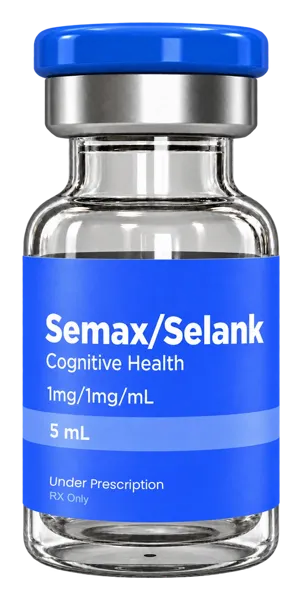 See it at Bodybuilding Peptides