Selank vs Semax: what is the difference?
The short answer
Selank and Semax come from the same Russian laboratory but are studied for different goals. Semax, built from a fragment of the hormone ACTH, is studied mainly for cognition, focus and neuroprotection. Selank, built from the immune peptide tuftsin, is studied mainly for anxiety and stress. The evidence for both is early: mostly animal studies and small Russian trials.
Selank and Semax are the two peptides most associated with the “Russian nootropic” category, and they are constantly mixed up because they were developed by the same laboratory and share part of their molecular structure. They are not interchangeable. Semax is studied mainly for cognition, focus, and neuroprotection; Selank is studied mainly for anxiety and stress. Neither is approved by the FDA, and most of the human research comes from Russia. This page compares them on origin, structure, mechanism, what each is actually studied for, how strong that evidence is, whether they can be used together, what they cost, and what people who use them are saying, using primary literature rather than vendor copy. For the deeper cognition picture, see our companion explainer on what Semax is studied for; for the anxiety and stress side, see Selank and the anxiety and stress response.
Where do Selank and Semax come from?
Selank and Semax were both developed in Russia at the Institute of Molecular Genetics of the Russian Academy of Sciences, which is the main reason they get grouped together. Both are short synthetic heptapeptides (seven amino acids), and both were engineered the same way: by attaching the tripeptide tail Pro-Gly-Pro onto a naturally occurring peptide fragment to make the molecule more resistant to enzymatic breakdown and longer-acting. The fragments they start from are different, and that is where the two peptides genuinely diverge. Semax is built from a fragment of adrenocorticotropic hormone (ACTH): its sequence is Met-Glu-His-Phe-Pro-Gly-Pro, corresponding to the ACTH(4-7) fragment with the Pro-Gly-Pro tail added, and it is often described in the literature as an analog of ACTH(4-10) (Medvedeva et al., 2014; Dolotov et al., 2006). Because Semax reproduces only this short neurotropic ACTH fragment rather than the full 39-amino-acid hormone, it is studied for brain effects, not for the adrenal, cortisol-releasing action of intact ACTH. Selank is built from tuftsin, an endogenous immune-modulating peptide; its sequence is Thr-Lys-Pro-Arg-Pro-Gly-Pro, which is the tuftsin sequence Thr-Lys-Pro-Arg with the same Pro-Gly-Pro tail (Kasian et al., 2017). So the shared “Russian nootropic” label hides a real difference in lineage: one descends from a stress-hormone fragment, the other from an immune peptide.
How do Selank and Semax work?
Selank and Semax work through different primary mechanisms, which tracks with their different lineages. Semax’s most-studied action is on neurotrophins: in rat studies, a single 50 µg/kg dose raised BDNF (brain-derived neurotrophic factor) protein roughly 1.4-fold and increased trkB receptor phosphorylation about 1.6-fold in the hippocampus, alongside larger rises in BDNF and trkB messenger RNA (Dolotov et al., 2006). In rodent models of stroke, Semax shifts brain gene expression toward immune-modulating and vascular programs and is described as supporting neuron survival under low-oxygen and excitotoxic stress (Medvedeva et al., 2014). Selank’s most-studied action points to the inhibitory GABA system: in a rat chronic-stress model it enhanced the anti-anxiety effect of the benzodiazepine diazepam, and the authors reported that it can influence the binding of GABA to GABA-A receptors, consistent with a calming, anxiolytic profile rather than a stimulant one (Kasian et al., 2017). The two do overlap on neurotrophins, intranasal Selank has also been shown to regulate BDNF expression in the rat hippocampus (Inozemtseva et al., 2008), but the front-line mechanism differs: Semax leans neurotrophic and neuroprotective, Selank leans GABAergic and anxiolytic.
What is each peptide studied for?
Semax is studied mainly for cognition, focus, and neuroprotection, while Selank is studied mainly for anxiety, stress, and asthenia (fatigue). In Russia, Semax has been used clinically in the setting of ischemic stroke and cognitive complaints: a 2018 study of 110 stroke-rehabilitation patients found that Semax administration was associated with higher plasma BDNF levels and faster functional recovery on the Barthel index (Gusev et al., 2018). That is a neurological-recovery signal in patients, not proof of a “focus” benefit in healthy people. Selank’s clearest human signal is in anxiety: a 2008 trial in 62 patients with generalized anxiety disorder and neurasthenia compared Selank (30 patients) against the benzodiazepine medazepam (32 patients) using the Hamilton, Zung, and CGI scales, and reported broadly similar anxiolytic effects, with Selank additionally showing anti-asthenic and psychostimulant properties (Zozulia et al., 2008). In short: if the goal language is focus, memory, and mental sharpness, the peptide with the matching research is Semax; if the goal language is anxiety, stress, and burnout, it is Selank. Neither claim rises to an FDA-recognized indication in the United States.
How strong is the evidence?
The evidence for both peptides is early-stage and heavily concentrated in Russia, which is the single most important caveat on this page. Much of the mechanistic work is preclinical, rats and mice, not people (Dolotov et al., 2006; Medvedeva et al., 2014; Kasian et al., 2017). The human trials that do exist are mostly small, run at Russian centers, and often published in Russian-language journals, which limits independent replication and Western regulatory recognition: the Selank anxiety trial enrolled 62 patients (Zozulia et al., 2008) and the Semax stroke-rehabilitation study 110 (Gusev et al., 2018). The closest thing to a head-to-head in people is a 2020 brain-imaging study in 52 healthy participants who received Semax, Selank, or placebo before resting-state fMRI scans; it found general and specific effects of each peptide on connectivity between the right amygdala and the right temporal cortex, a brain-network measurement rather than a test of anxiety or focus (Panikratova et al., 2020). There are no large, multi-site, placebo-controlled Western trials establishing that either peptide improves cognition or anxiety in otherwise healthy adults, and neither has the kind of dossier that underpins an FDA approval. That does not make the research worthless, it means the honest evidence level for both is “promising early signals, mostly preclinical and small-trial,” not “clinically proven.” Any source that calls either peptide a proven cognitive enhancer or a proven anxiety remedy is overstating what the literature actually supports. PeptideAgent’s Semax vs Selank comparison reads the record the same way, describing both evidence bases as weak and published in Russian, and adds where each one stands with US regulators.
Selank vs Semax, side by side
Side by side, Selank and Semax share an origin and a structural backbone but separate on almost everything a reader actually chooses between: which system they act on, what the research targets, and how strong that research is. The table below maps origin, structure, primary mechanism, main research focus, evidence level, what community posts say people use each for, US approval status, and controlled-substance status. Read it as an orientation map, not a scoreboard: there is deliberately no “winner” row, because the two peptides are studied for different goals.
| Attribute | Selank | Semax |
|---|---|---|
| What it is | Heptapeptide analog of the immune peptide tuftsin (+ Pro-Gly-Pro) | Heptapeptide analog of an ACTH fragment (ACTH 4-7 + Pro-Gly-Pro) |
| Amino-acid sequence | Thr-Lys-Pro-Arg-Pro-Gly-Pro | Met-Glu-His-Phe-Pro-Gly-Pro |
| Where it was developed | Institute of Molecular Genetics, Russia | Institute of Molecular Genetics, Russia |
| Primary mechanism studied | GABAergic modulation; enhances diazepam (anxiolytic) | Raises BDNF / trkB neurotrophic signaling |
| Main research focus | Anxiety, stress, asthenia | Cognition, focus, neuroprotection, stroke recovery |
| Strongest human signal | Generalized anxiety disorder vs a benzodiazepine (62-patient trial) | Stroke-rehabilitation recovery (small Russian trials) |
| Evidence level | Mostly preclinical and small Russian trials | Mostly preclinical and small Russian trials |
| What community posts say it is used for | Calm and anxiety relief, often described as non-sedating | Focus, pattern recognition, skill building |
| Approved by the FDA (US) | No | No |
| Controlled substance (US) | No | No |
Can Semax and Selank be used together?
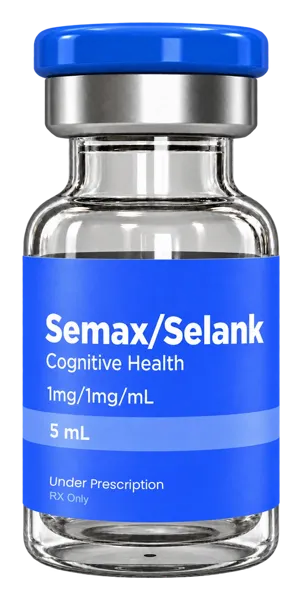
People do combine them, and combination products exist, but we found no published trial that tested the two together. In community posts, Semax is usually framed as the focus half of the pair and Selank as the calming, non-sedating half, and some posters mention combined intranasal formulations that contain both (Community Insights, July 2026). Our Selank nasal spray guide covers why Selank is almost always discussed in its nasal form. Products that put both peptides in a single vial are also sold online; one storefront lists a Semax / Selank injectable at 1 mg of each per mL (catalog checked October 12, 2026). On the evidence side, a PubMed search for studies naming both peptides turns up laboratory and animal work, the brain-imaging study above, which gave each peptide to a separate group rather than combining them (Panikratova et al., 2020), and a Belgian lab analysis of seized preparations that contained Selank and Semax, whose authors note the peptides are freely sold online as powders for injection or as nasal sprays (Vanhee et al., 2020). So the pairing rests on the logic of their separate research profiles, focus plus calm, not on any study of what happens when they are taken together. We do not publish a combined dosing chart, because no trial supports one.
What do Semax and Selank cost?
Prices vary by seller and form, and the figures below are one storefront’s listed monthly prices, not a market average. As of October 12, 2026, Bodybuilding Peptides lists its Semax / Selank combination at $274 per month, or $217 per month on a three-month plan; its Semax nasal spray at $188 per month, or $152 per month on a three-month plan; and its Selank nasal spray at $188 per month, with no three-month plan shown. Those are the prices shown on the product pages; the checkout side was not re-checked. Either way, the cost of a peptide says nothing about how strong its evidence is: the price buys a product, not the large trials neither peptide has.
What is the community saying about Selank and Semax?
The community treats the two as a pair with different jobs. Our Community Insights summaries (13 Semax posts and 9 Selank posts on X, collected in July 2026) found that people mostly describe Semax as their focus peptide, mentioning sharper attention, pattern recognition, and skill building, often inside wider nootropic stacks. Selank is mostly discussed for anxiety; several posters describe it as an “anxiolytic with no sedation,” and some point to the trial that compared it with a benzodiazepine. Stacking the two together is one of the most common themes for both. These are personal reports from a small sample of posts, not measured outcomes, and the summaries flag them as anecdotal. The pattern does line up with the research split on this page: Semax for cognition, Selank for anxiety and stress.
So which one is right for you?
The more useful question is which goal you are trying to solve. If your aim is cognition, focus, or recovery, Semax is the peptide with the closest-matching research; if your aim is anxiety, stress, or burnout, Selank is. But “closest-matching research” is early-stage and mostly preclinical, so it is worth bringing that goal, not just a peptide name, to a licensed provider. A provider can assess what you are experiencing, order appropriate labs, and weigh evidence-supported, monitored options, which may look different from either peptide in the headline. Anxiety in particular deserves a real evaluation, because approved treatments exist. Our overview of nootropic peptides and what the evidence supports and our explainer on what Semax is studied for turn this comparison into questions you can actually ask.
Status: Semax: Not FDA-approved; sold by some telehealth providers as a compounded prescription. An FDA advisory committee reportedly voted in July 2026 to recommend allowing pharmacies to compound it; nothing has changed yet. Selank: Not FDA-approved; sold by some telehealth providers as a compounded prescription. What these status terms mean.
Educational information only, not medical advice. Research statements are sourced to the peer-reviewed literature linked above; community statements summarize our Community Insights data and are anecdotal; prices are as listed on October 12, 2026. Updated October 12, 2026.
Sources (9)
Advertising disclosure: links marked "Paid link" go to Bodybuilding Peptides (trybbpeptides.com), an affiliate destination, and Cognition Protocols may earn a commission if you buy there. Our coverage is independent of that relationship, and nothing on this page is medical or legal advice.
 See it at Bodybuilding Peptides