Nootropic peptides vs traditional nootropics: which is actually worth it?

The short answer
Traditional nootropics like caffeine and L-theanine are inexpensive and backed by controlled human trials, mostly for alertness and attention. Nootropic peptides such as Semax and Selank have more novel mechanisms but rest mostly on animal studies and small Russian trials, often in patients rather than healthy people. On evidence and cost, the traditional options lead today.
“Nootropic peptides versus traditional nootropics” is really a question about trade-offs, and the honest answer is that the two categories are not on equal footing today. Traditional nootropics (caffeine, L-theanine, and the well-worn combinations built on them) are cheap, widely sold, and supported by controlled human trials. Peptides like Semax and Selank carry an aura of being more advanced, but their human evidence is thin and mostly Russian. This page compares the two on the dimensions that decide the question in practice: how good the evidence is, what each is actually used for, what it costs, and what the nootropic community says about both. For how the two peptides differ from each other, see our Selank vs Semax comparison; for the broader landscape, see our overview of nootropic peptides for focus and stress in 2026.
What is the difference between nootropic peptides and traditional nootropics?
The core difference is evidentiary and practical, not just chemical. “Traditional nootropics” are ordinary, widely available compounds (caffeine, the tea amino acid L-theanine, and their combinations) that have been tested in controlled human studies. “Nootropic peptides” are short synthetic peptide chains, most prominently Semax (an analog of a fragment of the hormone ACTH) and Selank (an analog of the immune peptide tuftsin), sold online as nasal sprays or as powders for injection (Vanhee et al., 2020) and studied mostly in animals and in small trials outside the United States. So the categories differ on several axes at once: how much rigorous human data exists, how the compound is taken, and what it costs. A caffeine-plus-L-theanine capsule and a vial of Semax are not two flavors of the same thing: one is a consumer product with a real trial record, and the other is an unapproved peptide with a much thinner one.
How strong is the evidence for each?
The evidence base is markedly stronger and more relevant for traditional nootropics, though it is not unlimited for either. Caffeine and L-theanine have been studied in randomized, placebo-controlled human trials, including in healthy adults, which is exactly the population most people asking this question belong to. Semax and Selank, by contrast, rest largely on preclinical work (rats and mice) plus a small number of Russian clinical studies, often in patients (stroke rehabilitation, anxiety disorders) rather than healthy people seeking an edge, and frequently published in Russian-language journals that limit independent replication and Western regulatory recognition. That does not make the peptide research worthless; it means the honest evidence level for Semax and Selank is “early signals, mostly preclinical and small-trial,” while for caffeine and L-theanine it is “modest but repeatedly demonstrated in controlled human trials.” When the two categories are placed side by side, the traditional options simply have the kind of data the peptides do not yet have.
What does the research on traditional nootropics actually show?
Caffeine has the most consistent human evidence for the everyday goals people chase: alertness and attention. A large review of caffeine’s effects concluded that following low (around 40 mg) to moderate (around 300 mg) doses, “alertness, vigilance, attention, reaction time” improve, while “less consistent effects are observed on memory and higher-order executive function, such as judgment and decision making” (McLellan et al., 2016). In other words, caffeine reliably sharpens the basic attentional machinery but is not a proven memory or decision-making enhancer. L-theanine is more modest: a 2025 systematic review and meta-analysis of five randomized controlled trials in 148 healthy adults found that “the beneficial effects of l-theanine on cognitive performance could not be confirmed by all test methods,” with a dose-dependent signal on visual processing at 200-400 mg but no effect on simple reaction time or the Stroop task, and GRADE-rated low or very low certainty (Mátyus et al., 2025). The frequently cited caffeine-plus-L-theanine combination has direct trial support too, though often small: a four-way crossover trial in children with ADHD found the combination “improved total cognition composite” and go/no-go performance, while caffeine alone worsened inhibitory control (Kahathuduwa et al., 2020). The takeaway is honest and unglamorous: real but moderate benefits, best established for attention, in legal compounds you already know.
What does the research on Semax and Selank actually show?
Semax and Selank show intriguing mechanisms but far weaker human proof, especially for healthy-adult “focus.” Semax’s most-cited action is on neurotrophins: in rats, a single dose raised BDNF (brain-derived neurotrophic factor) and increased trkB receptor signaling in the hippocampus (Dolotov et al., 2006), a preclinical finding, not a demonstration of sharper thinking in people. Its clearest human data is in disease, not enhancement: a 2018 study of 110 stroke-rehabilitation patients associated Semax with higher plasma BDNF and faster functional recovery (Gusev et al., 2018), a neurological-recovery signal that does not transfer to a healthy user wanting more focus. Selank’s strongest human signal is in anxiety rather than cognition: a 62-patient trial compared it against a benzodiazepine and reported broadly similar anxiolytic effects (Zozulia et al., 2008). There are no large, multi-site, placebo-controlled Western trials showing that either peptide improves cognition in otherwise healthy adults. So the peptide category currently offers a compelling story and thin proof: the opposite of what most people assume when they treat peptides as the “next level” beyond caffeine.
Nootropic peptides vs traditional nootropics, side by side
Side by side, the two categories separate cleanly on evidence and cost, and the traditional options lead on both today. The table below maps what each category is, its best-studied benefit, its evidence level, its US approval and controlled-substance status, and its rough cost. Read it as an orientation map: the peptides win on novelty of mechanism, not on human data.
| Attribute | Nootropic peptides (Semax / Selank) | Traditional nootropics (caffeine / L-theanine) |
|---|---|---|
| What it is | Synthetic peptides, sold as nasal sprays or injectables | Common consumer compounds (stimulant + tea amino acid) |
| Best-studied benefit | Neuroprotection / recovery (Semax); anxiety (Selank) | Alertness, vigilance, attention (caffeine) |
| Human evidence in healthy adults | Little to none; mostly preclinical or patient studies | Randomized, placebo-controlled trials exist |
| Evidence level | Early signals, mostly preclinical and small Russian trials | Modest but repeatedly demonstrated in human trials |
| Approved by the FDA (US) | No | No |
| Controlled substance (US) | No | No |
| Typical cost | $152 to $274 per month at one storefront (Oct 12, 2026) | Low, ordinary retail products |
How much do nootropic peptides cost compared with traditional nootropics?
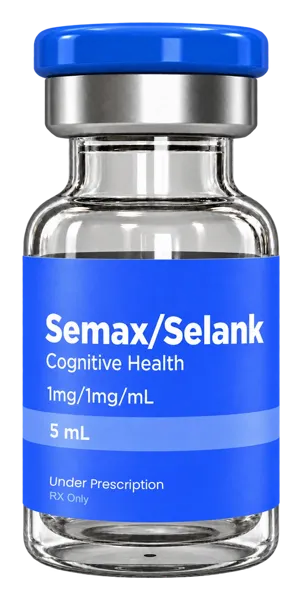
The peptides cost far more. As of October 12, 2026, one storefront, Bodybuilding Peptides, lists its Semax nasal spray at $188 per month ($152 per month on a three-month plan), its Selank nasal spray at $188 per month, and its Semax / Selank combination at $274 per month ($217 per month on a three-month plan), as shown on its product pages. Caffeine and L-theanine are ordinary low-cost retail products sold by many brands, with no prescription or monthly plan involved. Price does not track evidence here: the cheaper side of this comparison is also the better-tested one.
What is the nootropic community saying?
In nootropic circles, peptides are usually added to a stack rather than swapped in for the basics. Our Community Insights summary of 13 Semax posts on X (July 2026) found users placing Semax inside wider cognitive stacks next to Selank, phenylpiracetam, bromantane, and modafinil-type substances, and describing it as their focus peptide; Selank is mostly framed as the calming partner. Those are personal combinations, not tested protocols, and none of the posts report measured outcomes. The research on this page suggests a more modest framing: caffeine’s attention benefit is the best-documented effect in either category, and the peptides’ effects on focus in healthy people have not been measured in large trials.
So which is actually worth it?
For almost anyone weighing the two, the traditional nootropics are the defensible starting point: they are inexpensive, standardized, and backed by the kind of human trials the peptides lack. That is not a claim that caffeine and L-theanine are powerful; their benefits are real but modest and best established for attention, not memory or decision-making. It is a claim about evidence per dollar. The peptides may look like the more advanced option, but “more advanced-sounding” is not the same as “better proven.” If your goal is focus, mental performance, or clear thinking, it is worth bringing that goal, not a compound name, to a licensed provider who can assess what is actually going on (sleep, stress, nutrition, underlying conditions) and weigh evidence-supported, monitored options. For the two peptides in more depth, see what Semax is studied for and Selank and the anxiety and stress response.
Status: Semax: Not FDA-approved; sold by some telehealth providers as a compounded prescription. An FDA advisory committee reportedly voted in July 2026 to recommend allowing pharmacies to compound it; nothing has changed yet. Selank: Not FDA-approved; sold by some telehealth providers as a compounded prescription. What these status terms mean.
Educational information only, not medical advice. Research statements are sourced to the peer-reviewed literature linked above; community statements summarize our Community Insights data and are anecdotal; prices are as listed on October 12, 2026. Updated October 12, 2026.
Sources (8)
Advertising disclosure: links marked "Paid link" go to Bodybuilding Peptides (trybbpeptides.com), an affiliate destination, and Cognition Protocols may earn a commission if you buy there. Our coverage is independent of that relationship, and nothing on this page is medical or legal advice.
 See it at Bodybuilding Peptides