Semax nasal spray: why the studies used the nose, and how it compares with injection

The short answer
Semax is a seven-amino-acid peptide built from a fragment of the hormone ACTH, developed in Russia and used there mainly for stroke. It was studied almost entirely as a nasal solution, which is why most people use a Semax nasal spray. We found no human trial of injected Semax, and in a rat comparison the nasal route was more potent for learning.
Most people who take Semax take it as a nasal spray, and that is not a vendor whim. Semax was developed and studied as an intranasal peptide, so the Semax nasal spray is closer to the original than the injectable vials sold alongside it. Online, the injection is often pitched as the “stronger” upgrade. The research tells a more careful story. This page covers what Semax is, why nasal Semax is the route the studies used, how the spray compares with injection side by side, what is known about side effects, what it costs, and what people using Semax spray say about it.
What is Semax, and what is Semax peptide good for?
Semax is a synthetic seven-amino-acid peptide (Met-Glu-His-Phe-Pro-Gly-Pro) made from the 4 to 7 fragment of the hormone ACTH plus a Pro-Gly-Pro tail that “augments the peptide’s stability” (Dmitrieva et al., 2009). It was developed at the Russian Academy of Sciences and is used in Russia for stroke, Parkinson’s, ocular nerve atrophy and some other neurological conditions, according to a Cognitive Vitality report from the Alzheimer’s Drug Discovery Foundation (ADDF report). In the online posts we track, it is mostly discussed as a focus or “nootropic” peptide.
What it is actually good for, on the evidence, is narrower than its reputation. The ADDF report concludes that Semax “may be beneficial in stroke patients” but that well-conducted published studies are lacking, and that there is little evidence it improves cognition in healthy people. In plain terms, the evidence level is: a few small human studies, mostly Russian, plus a larger body of animal work. For the full research picture on cognition, see Semax and cognitive function: what is studied, and for the broader overview, the Semax monograph on The Treatment Report.
Why is Semax a nasal spray? Which form was actually studied?
Nasal Semax is the form the research used. The ADDF report notes that “Semax is usually taken intranasally (by a dropper)”, meaning the Russian clinical form is a nasal solution given as drops, and the sprays sold online are a variation on that same route. When you read that Semax “has been used” for stroke or cognition, that history is overwhelmingly intranasal. We found no published human trial of injected Semax. A Belgian lab that analyzed seized Semax and Selank preparations noted that these peptides are sold online both as powders for injection and as nasal sprays (Vanhee et al., 2020).
The reason for the nose is that swallowing a peptide does not work and the nasal lining offers a more direct path to the brain. A review of nose-to-brain peptide delivery puts it this way: “Orally administered peptides are poorly absorbed and rapidly destroyed by the stomach’s low pH and digestion of gastrointestinal enzymes” (Alabsi et al., 2022). The same review says the intranasal route “is a non-invasive method that enables drug delivery to the CNS, bypassing the BBB”, the blood-brain barrier, through the “trigeminal or olfactory nerves located in the upper part of the nasal cavity.” An injection puts the peptide into the bloodstream instead, where it still has to cross the blood-brain barrier to act centrally.
The review is just as clear about the limits. Nose-to-brain transport is “significantly affected by” a molecule’s size and chemistry, faces “metabolic enzymes in the mammalian olfactory mucosa,” and is constrained by “the small dose that can be administered,” making it “effective only for very potent drugs.” So a nasal spray is not a high-efficiency delivery system either. It is simply the route Semax was designed and studied around.
What is known about how nasal Semax is absorbed?
Only animal data exist, and they show a fast, small uptake into the brain. Using a radiolabeled version in rats, researchers found that “0.093% of the total introduced radioactivity per gram can be found in the rat brain 2 min after the administration,” of which “80% … belonged to Semax, and the rest, to its metabolites” (Shevchenko et al., 2006). The peptide breaks down quickly, and its Pro-Gly-Pro fragment, itself biologically active, accumulates. There is no published human pharmacokinetic study comparing a Semax nasal spray with an injection.
Does the route change how Semax behaves?
In rats, yes, and not in the direction injection sellers imply. A study comparing intranasal with intraperitoneal (injected into the abdomen) Semax reported that “Following intranasal administration, Semax was more potent in learning improvement compared to intraperitoneal administration,” while “the peptide failed to affect the animal pain sensitivity following intranasal administration as opposed to intraperitoneal administration” (Manchenko et al., 2010). The same study found Semax had both learning and pain effects after injection, and the authors concluded the two routes engage “different mechanisms and brain structures.” Taken together: both routes do something in rats, the nasal route was the stronger one for learning in the head-to-head study, and none of this has been tested in people.
What human research used nasal Semax?
There are few human studies, and the ones that state a route used nasal Semax. In a 2018 brain-imaging study, 24 healthy volunteers received intranasal Semax (14 people) or placebo (10 people), and scans 5 and 20 minutes later showed “a greater volume of the default mode network rostral (medial frontal cortex) subcomponent” in the Semax group (Lebedeva et al., 2018). That is a brain-network measurement, not a test of whether anyone thought or remembered better. The ADDF report counts the human evidence as two pilot studies in healthy people and two studies in stroke patients, with three of the four published only in Russian (the report could read just the abstract or a secondary citation). The evidence level for nasal Semax in people is therefore small pilot studies, and for injected Semax in people, none found.
Semax nasal spray vs injection: side by side
The short version: the nasal spray has the research history behind it, while the case for the injection rests mostly on marketing claims. The table below lines up the route used in studies, what is known about absorption, the one head-to-head animal result, the human evidence level, the practical differences and what users report.
| Attribute | Semax nasal spray | Semax injection |
|---|---|---|
| Route used in studies | Yes, intranasal (Russian form is drops) | Animal studies only; no human trial found |
| What is known about absorption | Rats: a small share reaches the brain within 2 minutes | Enters the bloodstream; must cross the blood-brain barrier |
| Head-to-head result (rats) | More potent for learning | Affected pain sensitivity; weaker for learning |
| Human evidence level | Small pilot studies, mostly Russian | None found |
| Practical differences | No needle; nasal delivery limited by small volumes | Needle and sterility questions on top of purity |
| What users report | The default way people describe taking it | Not a theme in our sample |
So is the injection “better” than the nasal spray?
The published evidence does not support calling the injection an upgrade. The Semax nasal spray is the form with the clinical history behind it, and in the one animal comparison of routes, the nasal path was the more potent one for learning. Putting more peptide into the bloodstream is not the same as putting more of it where it acts, and an injection trades away the nose-to-brain route Semax was designed around. The delivery-form debate is argued far more confidently online than the evidence allows.
What are the side effects of Semax nasal spray?
Little human safety data exists, so the honest answer is that the side-effect profile is thin rather than proven clean. The ADDF report states that “Little human evidence exists for potential side effects.” Citing a published review, it lists the most common reported adverse events as discoloration of the nasal cavity and a rise in blood glucose in people with diabetes, and says “Long-term side effects are unknown” and drug interactions are “Not known.” That makes people with diabetes, anyone on other brain-active medication, and anyone planning long, repeated use reasonable candidates for a conversation with a clinician first.
The other risk is what is in the bottle. Independent testing of the falsified peptide drugs most often seized on one national market found “a high variation in amount of drugs per unit,” “a low purity (ranging between 5% and 75% for cysteine containing peptides),” and arsenic “up to ten times the ICH toxicity limit for parenteral drugs” (Janvier et al., 2018). That applies to both forms, and it is sharper for an injectable, where a non-sterile or adulterated product goes straight past the body’s defenses.
Do people use Semax spray with Selank?
Yes, it is a frequent pairing in community posts, though no trial has tested the two together. Users describe Semax as the focus half and Selank as the calming half, and some mention combined intranasal products. Selank has its own nasal research history; see our Selank nasal spray guide and the side-by-side Selank vs Semax comparison.
How much does Semax nasal spray cost?
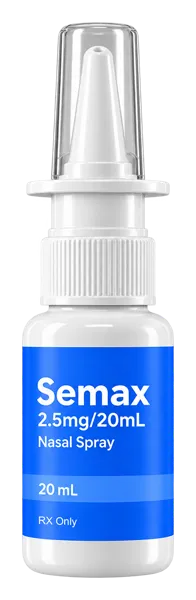
Price depends on the seller. As of October 12, 2026, Bodybuilding Peptides lists a Semax nasal spray (2.5 mg in 20 mL) at $188 per month, or $152 per month on a three-month plan, as shown on its product page; the checkout side was not re-checked. That is one storefront’s listed price, not a market average, and a higher or lower price says nothing about how much Semax a product actually contains, which is the quality question above.
What do people using Semax spray say?
In community posts, nasal Semax is simply how people describe taking it, and focus is why. Our Community Insights summary of 13 Semax posts on X (July 2026) describes Semax as “typically administered intranasally,” with users who “debate preparation liquids” and some saying it “does not irritate their nose.” In lists of popular peptides, commenters “label Semax as the one used for focus,” and individual users mention “pattern recognition and learning” as what they are after. Several describe using it for a limited period and then taking a break, a pattern they call cycling.
Stacks come up often. The summary found users placing Semax “within broader nootropic stacks alongside compounds like Selank, phenylpiracetam, bromantane, and modafinil-type substances,” and some favoring what they call amidated variants. The most common framing is the pair: Semax “as the focus component and Selank as the anti-anxiety or non-sedating calming component.”
Two cautions from the same data. The summary notes the posts “do not detail measured outcomes,” and its own sentiment note calls the mix anecdotal impressions, not measurements. No trial has tested cycling schedules, amidated variants or these stacks. For the full set of themes and the original posts, see our Semax community page.
Status: Not FDA-approved; sold by some telehealth providers as a compounded prescription. An FDA advisory committee reportedly voted in July 2026 to recommend allowing pharmacies to compound it; nothing has changed yet. What these status terms mean.
Educational information only, not medical advice, and not a guide to dosing. Research statements are sourced to the literature linked above and reflect mostly animal and small, mostly Russian human research; community statements summarize our Community Insights data and are anecdotal; prices are as listed on October 12, 2026. Drafted with AI assistance and fact-checked against the cited primary sources. Updated October 12, 2026.
Sources (8)
Advertising disclosure: links marked "Paid link" go to Bodybuilding Peptides (trybbpeptides.com), an affiliate destination, and Cognition Protocols may earn a commission if you buy there. Our coverage is independent of that relationship, and nothing on this page is medical or legal advice.
 See it at Bodybuilding Peptides